Your Source Code
Clear repository handover
Deliver 24/7 customer support with intelligent AI agents that answer from approved documentation and escalate complex cases seamlessly to human operators.
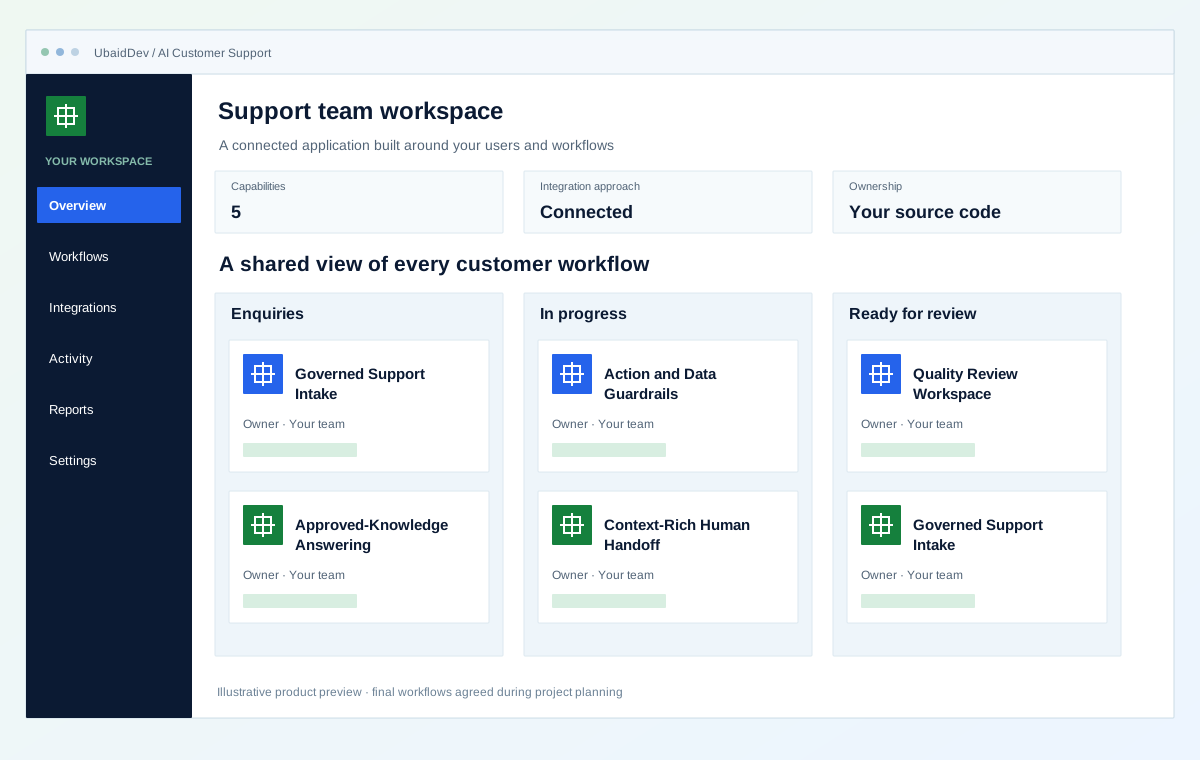
Clear repository handover
Integrations scoped to your tools
Validate each delivery phase
Documentation and onboarding
Define the result you need from ai customer support, then review it against real workflows.
Assist with routine classification and grounded response preparation while preserving review controls.
Move uncertain or sensitive requests to a person with the relevant conversation context attached.
Capture answer feedback and knowledge gaps as inputs for maintained support operations.
Choose the capabilities that fit your first release and the way your business works.
Normalize website, in-app, email, or messaging requests into a traceable support conversation.
Retrieve product and policy content with source context so answers can be reviewed and corrected.
Separate read-only lookups from approved actions and require confirmation for sensitive changes.
Route exceptions with the conversation, relevant facts, and reason for escalation attached.
Review sampled conversations, failure categories, feedback, and knowledge gaps without inventing outcome metrics.
Interactive operational simulation for ai customer support. Walk through the operational stages to inspect data contracts, user actions, and backend verification hooks before kickoff.
Illustrative screens and sample measurements. These are not live results or performance guarantees.
Normalize website, in-app, email, or messaging requests into a traceable support conversation.
Sample response · review requiredStage 1 of 3 · Triage
Normalize website, in-app, email, or messaging requests into a traceable support conversation.
Retrieve product and policy content with source context so answers can be reviewed and corrected.
Separate read-only lookups from approved actions and require confirmation for sensitive changes.
Agree on the workflows, review points and release checks before implementation begins.
Roles, authentication and data handling follow the agreed application scope.
Your repository and technical documentation are part of the delivery plan.
Review realistic scenarios, integrations and recovery paths before launch.
Validate the work in planned phases with clear owners and acceptance criteria.
Review the current problems and the people who need the system before selecting features.
Deliver 24/7 customer support with intelligent AI agents that answer from approved documentation and escalate complex cases seamlessly to human operators.
Illustrative operating states. Current measurements and acceptance criteria are confirmed during discovery.
These rows are conversation aids, not measured client results. We replace them with your current baseline, desired state, owner, and acceptance test before implementation begins.
During discovery, each row receives a current measurement, target, data owner, test method, and sign-off condition. Until then it remains illustrative scope.
Staff inspect each incoming message before routing it
The assistant proposes a category and queue for review
Answers require searching several approved documents
Relevant source passages appear beside the drafted response
Customers repeat context when a person joins
Conversation context and escalation reason travel with the case
A transparent process with decisions and handover planned at each stage.
Map channels, request classes, source systems, escalation ownership, and prohibited actions.
DiscoveryTest representative questions, retrieval behavior, response guidance, and unknown-answer handling.
PrototypeConnect selected channels, support queues, approved lookups, permissions, and audit events.
BuildRun acceptance fixtures, train reviewers, document fallback behavior, and release by bounded queue.
LaunchSelect the stack and connections around your environment, data and delivery requirements.
Confirm the final deliverables and ownership terms in the project scope.
Support request and escalation policy map
Grounded conversation service and selected channel adapters
Human handoff workspace with context and audit events
Evaluation fixtures, reviewer guide, and operating runbook
See how a business requirement becomes a practical system, with a clear scope and checks your team can review.
AI assistance & connected operations
Automate the routine. Keep people in control.
Fictional scenario name · Proposed implementation · Concept artwork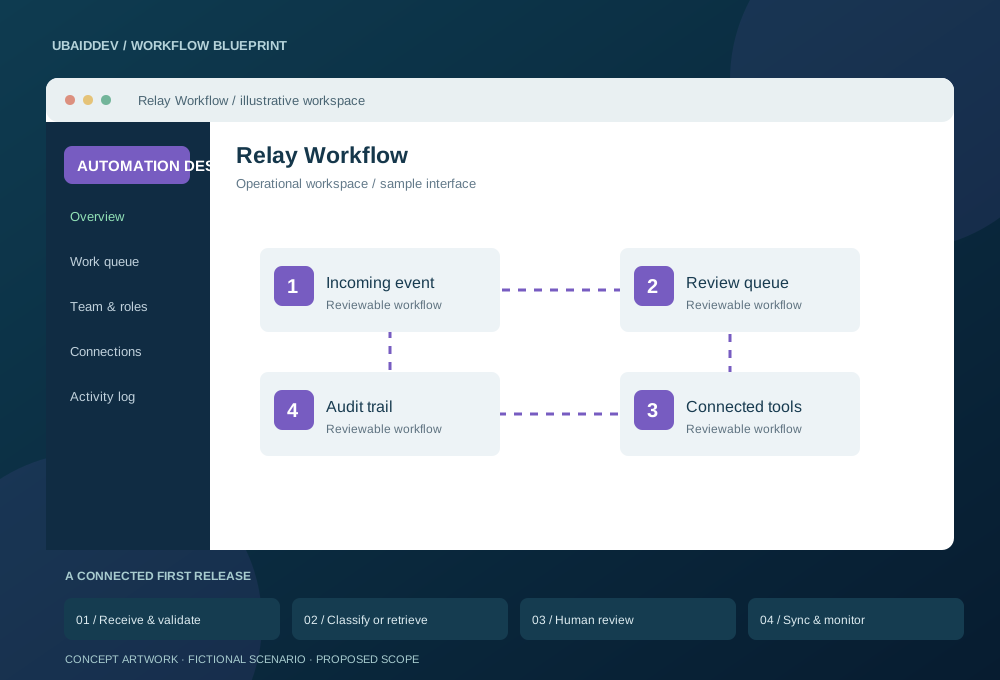
Operations staff copy enquiry details between tools and manually sort incoming documents. Exceptions need human judgement, but repetitive work should not hide the next action.
Use scoped API credentials, deduplication keys and bounded retries. Retrieved answers cite approved documents; uncertain or sensitive actions route to a reviewer. Messaging requires approved templates and appropriate consent.
Track review corrections, failed executions and manual handling time; evaluate AI answers against an agreed reference set.
Targets, baseline, timeline and commercial scope are agreed during discovery.
Agree working-hour overlap, written English updates, staging reviews, migration responsibilities and support scope. Confirm repository access, deployment documentation and ownership terms before work begins.
Choose a delivery tier, functional modules, integrations, and timeline to see an indicative range before discovery.
Explore the range without sharing your email. We confirm the final scope and price after reviewing your requirements.
Count a complete task, such as booking, invoicing or approving a request, as one workflow.
These selections travel with your brief. The range below is calculated from the tier, workflow count, connected systems and delivery pace.
This planning range uses the selected scope inputs. Final deliverables, exclusions, and milestone prices are confirmed in writing.
This does not place an order. We review the configuration and reply with the confirmed scope and milestone proposal.
Answers about scope, integrations, delivery and ownership.
Escalation rules are designed around confidence, request sensitivity, customer preference, account state, and tool failures. The handoff includes the conversation and reason so the support agent can continue without asking for the same context again.
Yes. Retrieval can be limited to approved product, policy, and support sources, with source context retained for review and a clear fallback when the system cannot find enough grounded information.
We assemble representative questions, expected source material, escalation cases, prohibited actions, and review criteria. Release decisions are based on those fixtures and your team's acceptance, not on invented performance claims.
Share your requirements and get a clear scope, delivery plan and quote.