Your Source Code
Clear repository handover
Build autonomous AI agents that use approved tools to complete business tasks. Configure action permissions, human approvals and real-time execution telemetry.
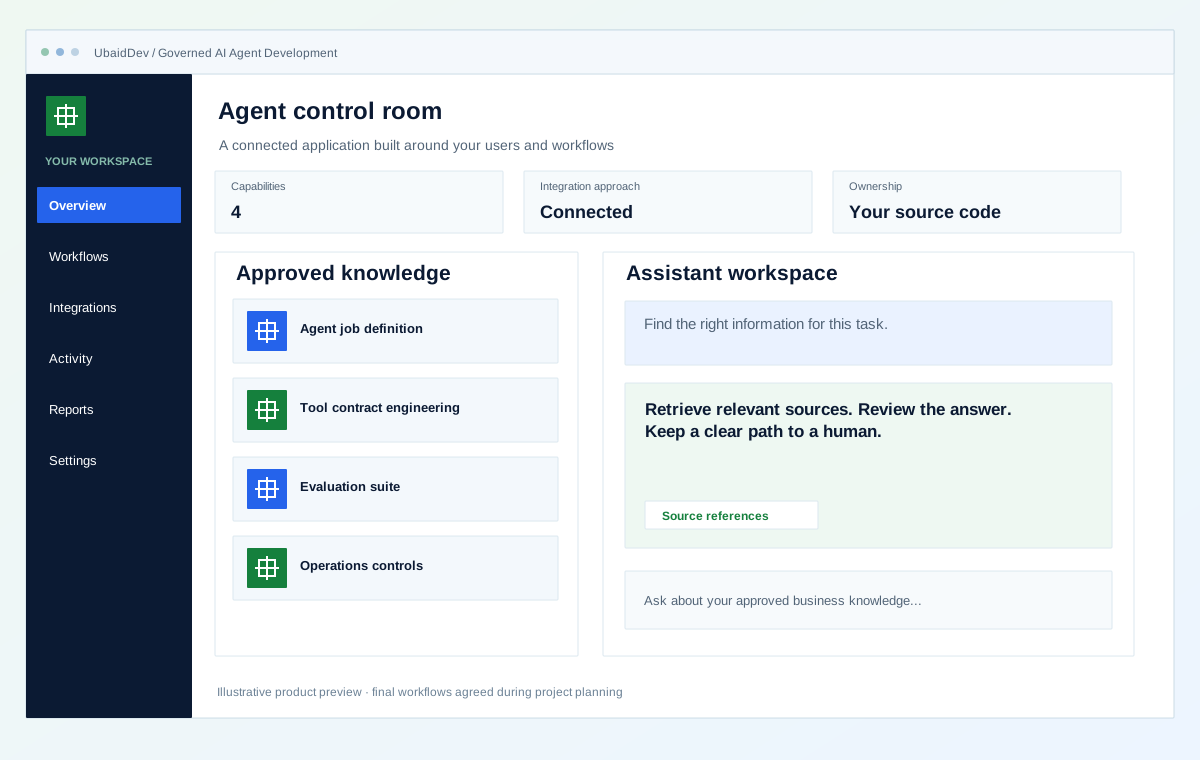
Clear repository handover
Integrations scoped to your tools
Validate each delivery phase
Documentation and onboarding
Define the result you need from governed ai agent development, then review it against real workflows.
Every tool exposes a narrow schema, permission rule, validation step, and explicit failure response.
Sensitive or irreversible actions wait for an authorized review instead of relying on model confidence alone.
Inputs, tool choices, approvals, outputs, and exceptions are recorded for operational review.
Choose the capabilities that fit your first release and the way your business works.
One valuable task is separated into decisions, tools, constraints, and escalation paths.
Typed inputs, allowlisted actions, idempotency, and permission checks wrap each integration.
Representative cases test correct action, refusal, clarification, and handoff behavior.
Audit views, limits, alerts, and a manual stop path support safe operation.
Interactive operational simulation for governed ai agent development. Walk through the operational stages to inspect data contracts, user actions, and backend verification hooks before kickoff.
Illustrative screens and sample measurements. These are not live results or performance guarantees.
One valuable task is separated into decisions, tools, constraints, and escalation paths.
Stage 1 of 3 · Task
One valuable task is separated into decisions, tools, constraints, and escalation paths.
Typed inputs, allowlisted actions, idempotency, and permission checks wrap each integration.
Representative cases test correct action, refusal, clarification, and handoff behavior.
Agree on the workflows, review points and release checks before implementation begins.
Roles, authentication and data handling follow the agreed application scope.
Your repository and technical documentation are part of the delivery plan.
Review realistic scenarios, integrations and recovery paths before launch.
Validate the work in planned phases with clear owners and acceptance criteria.
Review the current problems and the people who need the system before selecting features.
List the tools an agent may use and the decisions that need human approval. Define the information available to each task and the boundaries around it. A useful agent plan includes a record of what happened and a way to stop or recover an incomplete action.
An agent may prepare a customer follow-up after reading an approved record. Sending the message or changing the deal stage can remain a separate approval step, with the proposed action visible to the responsible person.
Test allowed and disallowed actions, incomplete tool responses and repeated requests. Review the action history and recovery path with the people who will supervise the workflow.
Give the agent one bounded job, a small approved tool set and explicit approval points. Record the actions it attempts and include a recovery path when information or a tool is unavailable.
More tools and longer workflows should follow evaluation of the first task, with separate decisions about permissions and human review.
A transparent process with decisions and handover planned at each stage.
Define what the agent may decide, what it may call, and what always needs approval.
Connect approved systems through validated, least-privilege actions.
Run expected, ambiguous, adversarial, and failure cases before release.
Start with review-heavy operation and widen only after evidence supports it.
Select the stack and connections around your environment, data and delivery requirements.
Confirm the final deliverables and ownership terms in the project scope.
Agent service source code
Versioned tool schemas and permission rules
Evaluation cases and review criteria
Audit, alerting, and human-approval workflow
See how a business requirement becomes a practical system, with a clear scope and checks your team can review.
AI assistance & connected operations
Automate the routine. Keep people in control.
Fictional scenario name · Proposed implementation · Concept artwork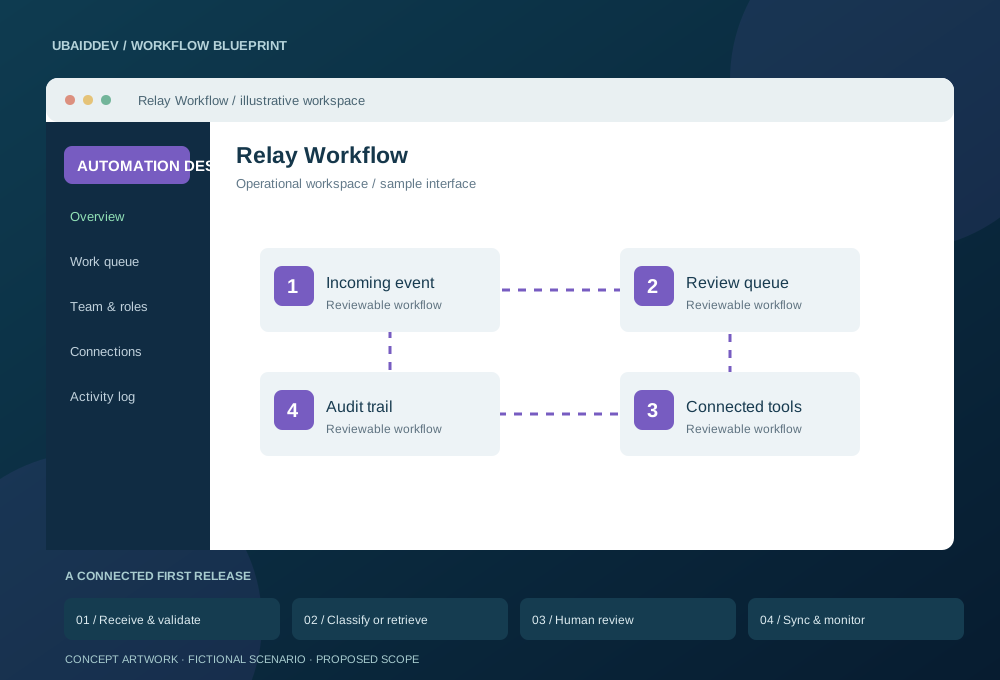
Operations staff copy enquiry details between tools and manually sort incoming documents. Exceptions need human judgement, but repetitive work should not hide the next action.
Use scoped API credentials, deduplication keys and bounded retries. Retrieved answers cite approved documents; uncertain or sensitive actions route to a reviewer. Messaging requires approved templates and appropriate consent.
Track review corrections, failed executions and manual handling time; evaluate AI answers against an agreed reference set.
Targets, baseline, timeline and commercial scope are agreed during discovery.
Agree working-hour overlap, written English updates, staging reviews, migration responsibilities and support scope. Confirm repository access, deployment documentation and ownership terms before work begins.
Choose a delivery tier, functional modules, integrations, and timeline to see an indicative range before discovery.
Explore the range without sharing your email. We confirm the final scope and price after reviewing your requirements.
Count a complete task, such as booking, invoicing or approving a request, as one workflow.
These selections travel with your brief. The range below is calculated from the tier, workflow count, connected systems and delivery pace.
This planning range uses the selected scope inputs. Final deliverables, exclusions, and milestone prices are confirmed in writing.
This does not place an order. We review the configuration and reply with the confirmed scope and milestone proposal.
Answers about scope, integrations, delivery and ownership.
A chatbot primarily manages a conversation. This service is for agents that select approved tools and perform bounded actions; conversational support remains on the AI chatbot page.
Yes, through a narrow API action with validated inputs, scoped credentials, idempotency where needed, and review rules for sensitive changes.
No. Approval is assigned by risk. Read-only lookups and reversible low-risk updates may run automatically, while sensitive or irreversible actions remain gated.
Share your requirements and get a clear scope, delivery plan and quote.