Your Source Code
Clear repository handover
Build and deploy production machine learning models, predictive pipelines, and enterprise AI integrations with verified data security and model evaluation.
Clear repository handover
Integrations scoped to your tools
Validate each delivery phase
Documentation and onboarding
Define the result you need from ai & machine learning development, then review it against real workflows.
Curated data pipelines, fine-tuning, and validation benchmarks prevent ungrounded outputs.
Monitored latency budgets, fallback models, and token cost caps maintain operational stability.
Confidence scoring, input logging, and human-in-the-loop review safeguard critical workflows.
Choose the capabilities that fit your first release and the way your business works.
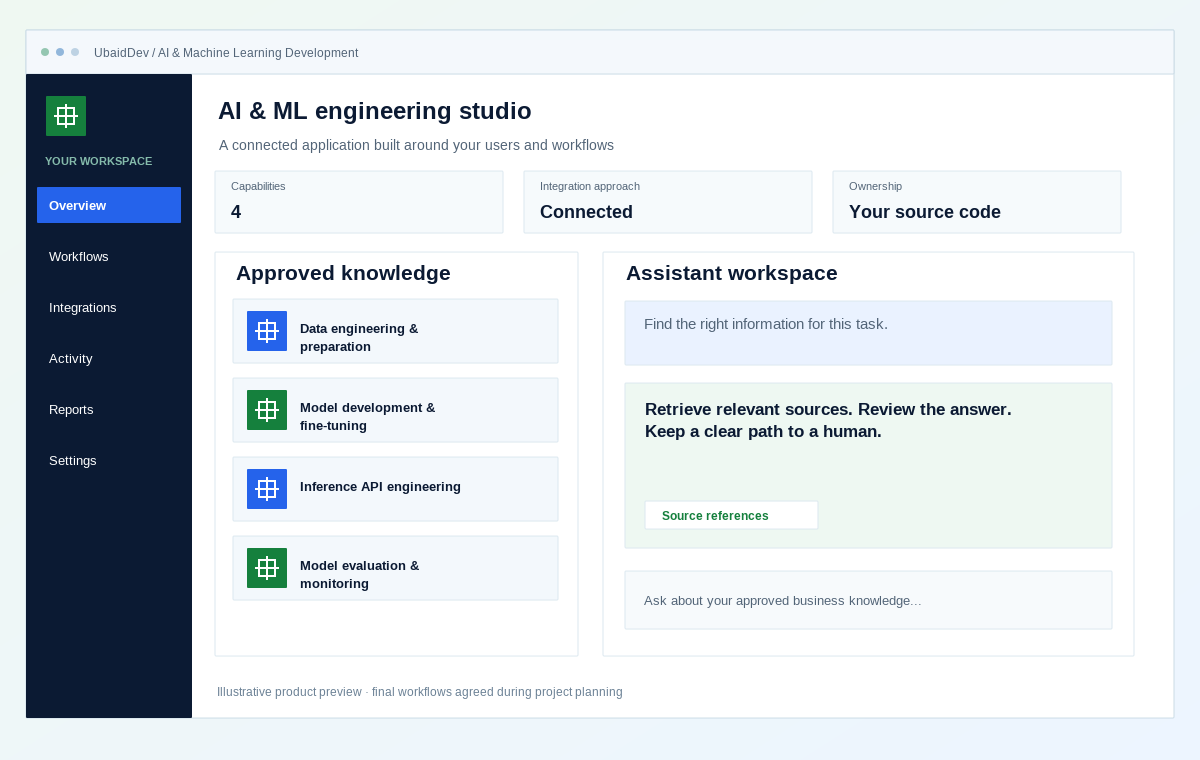
Dataset cleaning, feature extraction, normalization, and vector embedding pipelines.
Custom ML classifiers, regression algorithms, or domain-adapted LLM fine-tuning.
Low-latency FastAPI microservices wrapped with rate limits, caching, and guardrails.
Automated evaluation suites, drift detection, latency tracking, and audit logging.
Interactive operational simulation for ai & machine learning development. Walk through the operational stages to inspect data contracts, user actions, and backend verification hooks before kickoff.
Illustrative screens and sample measurements. These are not live results or performance guarantees.
POST /api/v1/ml/predict HTTP/1.1
{
  "task": "Data engineering & preparation",
  "input_tokens": 128,
  "vector_embedding_dim": 1536,
  "confidence_threshold": 0.95,
  "output_prediction": "Optimal Operational Decision",
  "data_privacy": "100% Private VPC (Zero External Training)"
}Stage 1 of 3 · Data
Dataset cleaning, feature extraction, normalization, and vector embedding pipelines.
Custom ML classifiers, regression algorithms, or domain-adapted LLM fine-tuning.
Low-latency FastAPI microservices wrapped with rate limits, caching, and guardrails.
Agree on the workflows, review points and release checks before implementation begins.
Roles, authentication and data handling follow the agreed application scope.
Your repository and technical documentation are part of the delivery plan.
Review realistic scenarios, integrations and recovery paths before launch.
Validate the work in planned phases with clear owners and acceptance criteria.
Review the current problems and the people who need the system before selecting features.
Start with the output a person or system needs and the cost of a wrong answer. Examine whether representative data is available and how success can be evaluated. Compare a simple baseline with the proposed model before planning a larger training or deployment investment.
A document classification tool may route incoming files to different teams. The review should consider uncertain and unfamiliar documents, and provide a manual route when the model cannot make a dependable classification.
Agree an evaluation dataset, baseline and review criteria. Document data handling, deployment ownership and the signals that indicate the model needs reassessment.
Choose one measurable task, review the available data and compare a baseline approach with the proposed model. Define evaluation examples, error handling and how a person reviews the output.
Larger datasets, additional model capabilities and wider production rollout should follow the evaluation results and an agreed monitoring and update process.
A transparent process with decisions and handover planned at each stage.
Assess data quality, target metrics, baseline performance, and technical feasibility.
Train baseline models, engineer features, evaluate accuracy against test benchmarks.
Wrap models in secure APIs, output validation filters, and fallback logic.
Deploy containerized inference endpoints with active telemetry and error reporting.
Select the stack and connections around your environment, data and delivery requirements.
Confirm the final deliverables and ownership terms in the project scope.
Trained model artifacts, weights, or fine-tuning pipelines
Data preprocessing scripts and validation test suites
Containerized inference API source code and documentation
Monitoring dashboards, guardrail policies, and operational runbook
See how a business requirement becomes a practical system, with a clear scope and checks your team can review.
AI assistance & connected operations
Automate the routine. Keep people in control.
Fictional scenario name · Proposed implementation · Concept artwork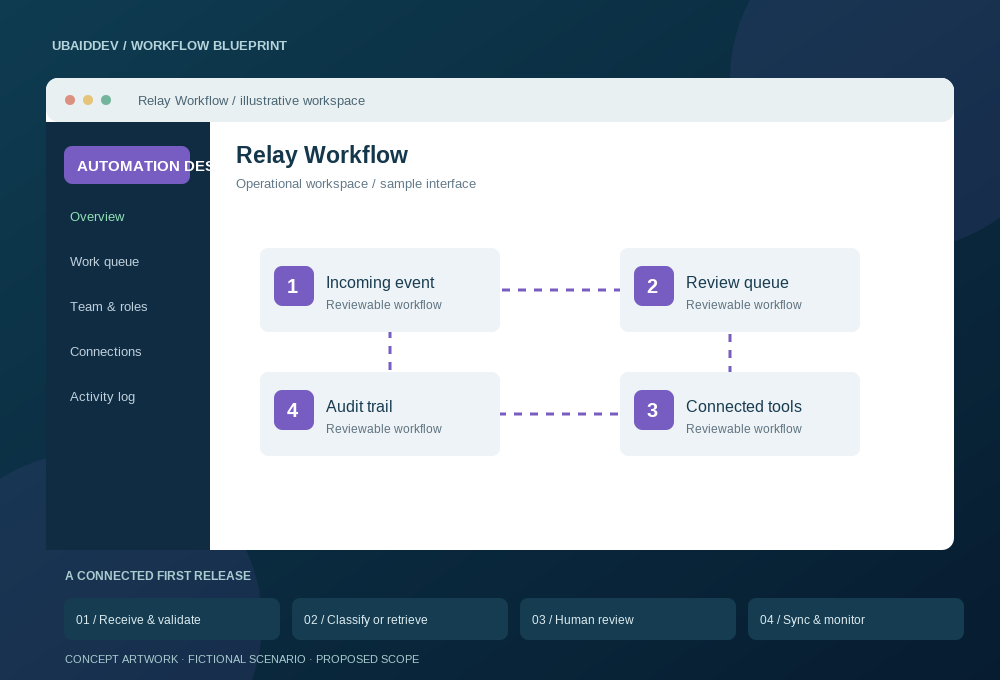
Operations staff copy enquiry details between tools and manually sort incoming documents. Exceptions need human judgement, but repetitive work should not hide the next action.
Use scoped API credentials, deduplication keys and bounded retries. Retrieved answers cite approved documents; uncertain or sensitive actions route to a reviewer. Messaging requires approved templates and appropriate consent.
Track review corrections, failed executions and manual handling time; evaluate AI answers against an agreed reference set.
Targets, baseline, timeline and commercial scope are agreed during discovery.
Agree working-hour overlap, written English updates, staging reviews, migration responsibilities and support scope. Confirm repository access, deployment documentation and ownership terms before work begins.
Choose a delivery tier, functional modules, integrations, and timeline to see an indicative range before discovery.
Explore the range without sharing your email. We confirm the final scope and price after reviewing your requirements.
Count a complete task, such as booking, invoicing or approving a request, as one workflow.
These selections travel with your brief. The range below is calculated from the tier, workflow count, connected systems and delivery pace.
This planning range uses the selected scope inputs. Final deliverables, exclusions, and milestone prices are confirmed in writing.
This does not place an order. We review the configuration and reply with the confirmed scope and milestone proposal.
Answers about scope, integrations, delivery and ownership.
We evaluate your use case during discovery. If existing commercial APIs meet accuracy and cost targets, we integrate them; if your domain requires proprietary data, unique classification, or lower cost, we develop custom models.
Yes. We build isolated data pipelines and self-hosted or private cloud endpoints where your proprietary data is never used to train public models or exposed externally.
You need sample data representing the inputs and desired outputs, plus clear success criteria such as classification precision, latency constraints, or error tolerance.
Share your requirements and get a clear scope, delivery plan and quote.