Your Source Code
Clear repository handover
Connect CRM systems and webhooks with self-hosted n8n workflows, idempotent retries, exception queues and client-owned Docker deployment.
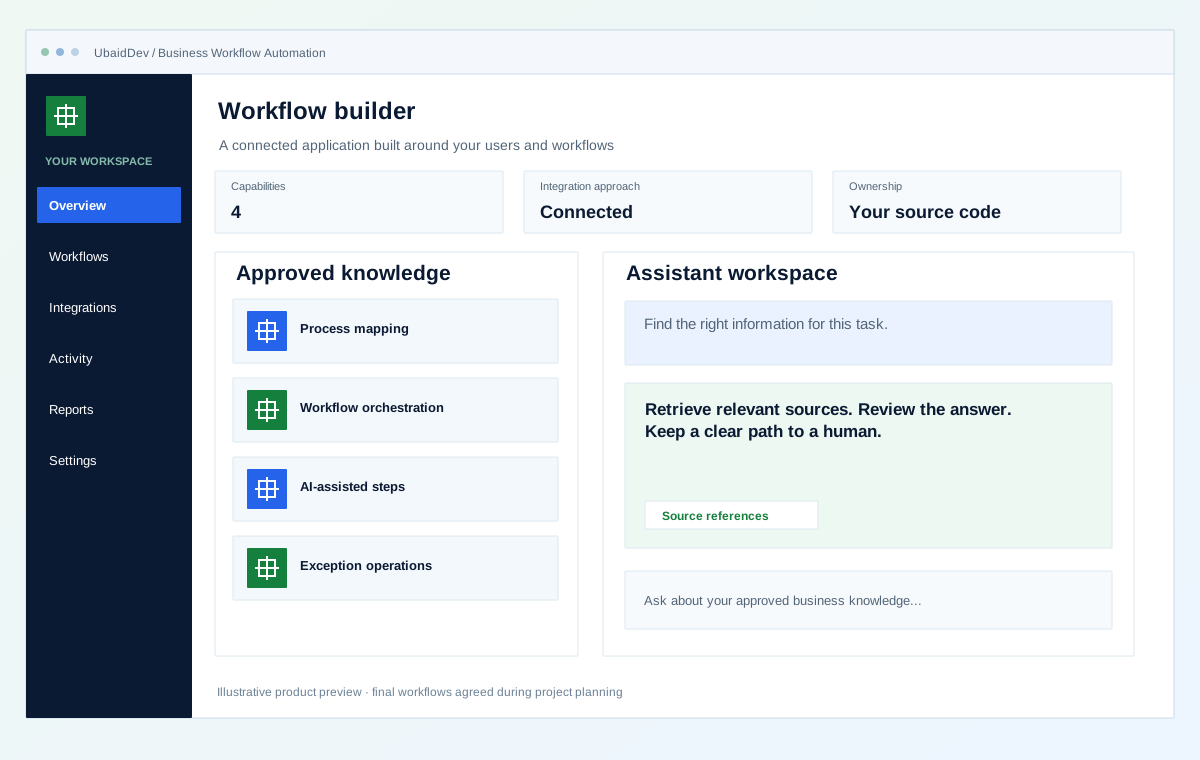
Webhook → signature and schema validation → durable event inbox → CRM lookup → IF / Switch routing → HTTP Request → delivery log. An event ID is unique per source so retries cannot create duplicate contacts, orders or notifications. A webhook is acknowledged after durable receipt; downstream work can continue asynchronously.
Use HTTP Request retry settings for transient failures, respect rate-limit responses, and bound retries with backoff. Route invalid credentials, rejected payloads and exhausted attempts to an Error Trigger workflow and a visible exception queue. The operator can correct and replay an event with the original idempotency key. Store minimal necessary payload data and redact credentials from execution logs.
Deploy a pinned n8n image and PostgreSQL using Docker Compose on your infrastructure. Configure HTTPS at the reverse proxy, the public WEBHOOK_URL, persistent volumes and a securely stored N8N_ENCRYPTION_KEY. Keep the editor restricted to authorized staff, back up the database and encryption key securely, set execution retention, and test restoration before launch. Higher-volume queue mode adds workers and Redis only when the measured workload requires it.
Acceptance checks include duplicate callbacks, expired credentials, CRM rate limits, timeout recovery, secret rotation and a backup restore. Hosting, model/API usage and any applicable n8n licensing are separate operating costs; self-hosting is not zero-cost operation.
n8n Docker documentation · n8n error handling
Estimate this automation scope →Clear repository handover
Integrations scoped to your tools
Validate each delivery phase
Documentation and onboarding
Define the result you need from business workflow automation, then review it against real workflows.
Defined triggers and rules move work through the same reviewed path each time.
Failed and ambiguous cases enter an owned queue instead of disappearing inside a script.
State, retries, approvals, and audit history make operational recovery possible.
Choose the capabilities that fit your first release and the way your business works.
Triggers, owners, decisions, systems, handoffs, and exceptions are documented.
Durable state coordinates steps without relying on one long-running request.
Classification or summarization is introduced only where uncertainty is expected and reviewable.
Queues, retry controls, notifications, and audit records support day-to-day ownership.
Interactive operational simulation for business workflow automation. Walk through the operational stages to inspect data contracts, user actions, and backend verification hooks before kickoff.
Illustrative screens and sample measurements. These are not live results or performance guarantees.
// Active Stage: Inbound Webhook
{
  "event_id": "evt_9024_acme",
  "status": "success",
  "source": "Process mapping",
  "transformed_records": 1,
  "milestone_verification": true,
  "client_owned_infrastructure": "100%"
}
Stage 1 of 3 · Trigger
Triggers, owners, decisions, systems, handoffs, and exceptions are documented.
Durable state coordinates steps without relying on one long-running request.
Classification or summarization is introduced only where uncertainty is expected and reviewable.
Agree on the workflows, review points and release checks before implementation begins.
Roles, authentication and data handling follow the agreed application scope.
Your repository and technical documentation are part of the delivery plan.
Review realistic scenarios, integrations and recovery paths before launch.
Validate the work in planned phases with clear owners and acceptance criteria.
Review the current problems and the people who need the system before selecting features.
Write down the trigger, inputs and owner of every important step. Decide which rules are fixed and which need judgement. Start with a workflow that is understood well enough to explain what should happen when a record is missing or a connected system is unavailable.
An approved purchase request may need a finance check before it becomes an order. A missing cost centre should create a visible review item, rather than leaving the request silently stuck between systems.
Rehearse missing data, duplicate events and external service failures. Confirm that retries and manual corrections leave a readable history.
Automate one repeated process with a clear trigger, required inputs and owner. Make duplicate requests, missing data and failed steps visible so a person can review or retry them.
Additional branches, connected systems and scheduled batches can follow once the first workflow has a reliable operating and exception-handling process.
A transparent process with decisions and handover planned at each stage.
Observe the current operation, including informal workarounds and exceptions.
Define deterministic rules, approvals, AI thresholds, and recovery behavior.
Connect each source and destination through documented contracts.
Compare automated and current outcomes before retiring manual steps.
Select the stack and connections around your environment, data and delivery requirements.
Confirm the final deliverables and ownership terms in the project scope.
Workflow map and ownership matrix
Automation source and integration contracts
Approval and exception queues
Runbook, alerts, and audit history
See how a business requirement becomes a practical system, with a clear scope and checks your team can review.
AI assistance & connected operations
Automate the routine. Keep people in control.
Fictional scenario name · Proposed implementation · Concept artwork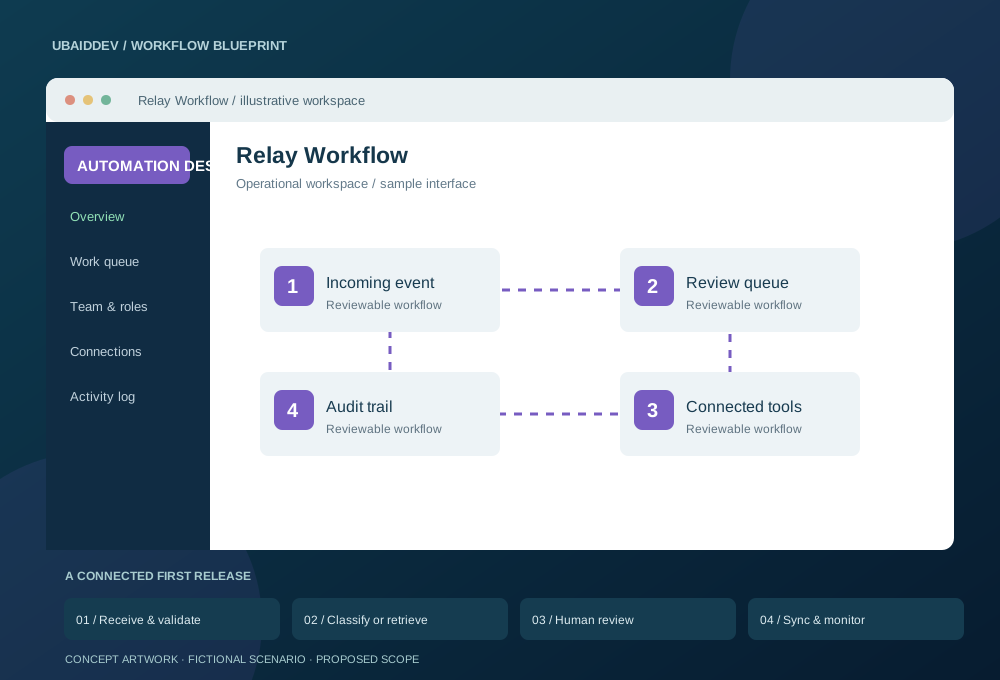
Operations staff copy enquiry details between tools and manually sort incoming documents. Exceptions need human judgement, but repetitive work should not hide the next action.
Use scoped API credentials, deduplication keys and bounded retries. Retrieved answers cite approved documents; uncertain or sensitive actions route to a reviewer. Messaging requires approved templates and appropriate consent.
Track review corrections, failed executions and manual handling time; evaluate AI answers against an agreed reference set.
Targets, baseline, timeline and commercial scope are agreed during discovery.
Agree working-hour overlap, written English updates, staging reviews, migration responsibilities and support scope. Confirm repository access, deployment documentation and ownership terms before work begins.
Choose a delivery tier, functional modules, integrations, and timeline to see an indicative range before discovery.
Explore the range without sharing your email. We confirm the final scope and price after reviewing your requirements.
Count a complete task, such as booking, invoicing or approving a request, as one workflow.
These selections travel with your brief. The range below is calculated from the tier, workflow count, connected systems and delivery pace.
This planning range uses the selected scope inputs. Final deliverables, exclusions, and milestone prices are confirmed in writing.
This does not place an order. We review the configuration and reply with the confirmed scope and milestone proposal.
Answers about scope, integrations, delivery and ownership.
No. Deterministic rules are preferable when the decision can be stated clearly. AI is reserved for uncertain inputs such as classification or summarization.
Yes, when those systems provide an approved API, webhook, export, or other reliable interface. Feasibility and ownership are confirmed before build.
The workflow records its state, applies bounded retry rules, and sends unresolved work to an owned exception queue with enough context to recover.
Yes. We scope Docker deployment, CRM credentials, signed webhooks, idempotent delivery, retries and a visible exception queue. Hosting, API usage and any applicable n8n licence are separate.
Share your requirements and get a clear scope, delivery plan and quote.