Your Source Code
Clear repository handover
Automate direct-to-consumer order processing, inventory sync across sales channels, warehouse dispatch notifications and hassle-free returns management.
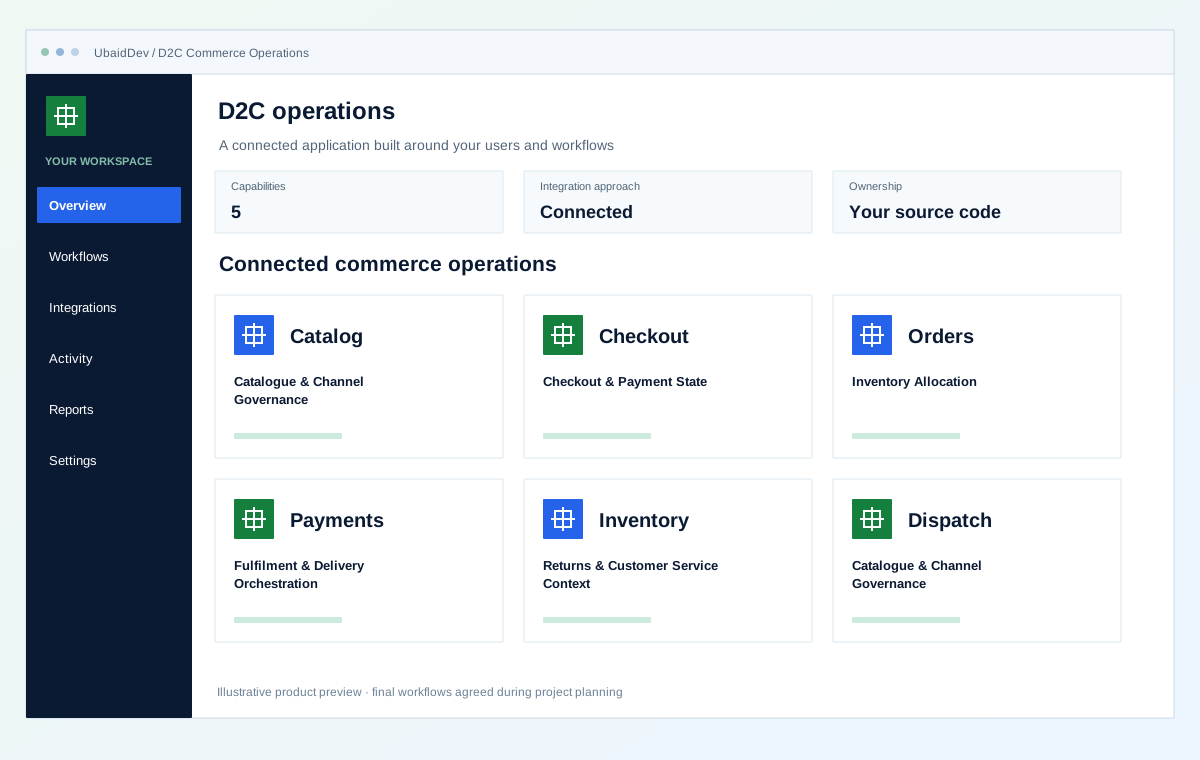
Clear repository handover
Integrations scoped to your tools
Validate each delivery phase
Documentation and onboarding
Define the result you need from d2c commerce operations, then review it against real workflows.
Connect confirmed commerce events while keeping ownership and failure state visible.
Use explicit availability, reservation, allocation, and release rules from an agreed source of truth.
Share return, refund, replacement, and support state without claiming unconfirmed actions succeeded.
Choose the capabilities that fit your first release and the way your business works.
Define product ownership, publishing rules, availability, promotions, and channel-specific exceptions.
Connect validated checkout, payment confirmation, failure, refund, and reconciliation events.
Coordinate available-to-sell, reservations, releases, substitutions, and source-location decisions.
Route confirmed orders to approved fulfilment locations and retain label, shipment, and delivery state.
Connect return eligibility, approval, receipt, refund, replacement, and support history.
Interactive operational simulation for d2c commerce operations. Walk through the operational stages to inspect data contracts, user actions, and backend verification hooks before kickoff.
Illustrative screens and sample measurements. These are not live results or performance guarantees.
Stage 1 of 3 · Order
Define product ownership, publishing rules, availability, promotions, and channel-specific exceptions.
Connect validated checkout, payment confirmation, failure, refund, and reconciliation events.
Coordinate available-to-sell, reservations, releases, substitutions, and source-location decisions.
Agree on the workflows, review points and release checks before implementation begins.
Roles, authentication and data handling follow the agreed application scope.
Your repository and technical documentation are part of the delivery plan.
Review realistic scenarios, integrations and recovery paths before launch.
Validate the work in planned phases with clear owners and acceptance criteria.
Review the current problems and the people who need the system before selecting features.
Automate direct-to-consumer order processing, inventory sync across sales channels, warehouse dispatch notifications and hassle-free returns management.
Illustrative operating states. Current measurements and acceptance criteria are confirmed during discovery.
These rows are conversation aids, not measured client results. We replace them with your current baseline, desired state, owner, and acceptance test before implementation begins.
During discovery, each row receives a current measurement, target, data owner, test method, and sign-off condition. Until then it remains illustrative scope.
Teams compare storefront, payment, and fulfilment exports manually
Confirmed events and exceptions appear in one operations view
Channels publish stock without one agreed availability rule
Reservation and allocation rules use an explicit source of truth
Support, warehouse, and finance track separate return states
A shared state machine connects receipt, decision, refund, and customer context
A transparent process with decisions and handover planned at each stage.
Map channels, data ownership, checkout, payment, stock, fulfilment, returns, support, and exception ownership.
DiscoveryReview representative purchase, failure, cancellation, fulfilment, return, and support journeys.
PrototypeImplement selected workflows, event contracts, adapters, retries, reconciliation, and operations visibility.
BuildTest representative channels and failures, document ownership, train operators, and stage release.
LaunchSelect the stack and connections around your environment, data and delivery requirements.
Confirm the final deliverables and ownership terms in the project scope.
Commerce data ownership, event, and exception map
Selected storefront-to-fulfilment workflow services
Approved platform, payment, inventory, courier, and support adapters
Operations dashboard, reconciliation tools, test fixtures, and runbook
See how a business requirement becomes a practical system, with a clear scope and checks your team can review.
B2B & retail commerce
A buying journey built around real order rules.
Fictional scenario name · Proposed implementation · Concept artwork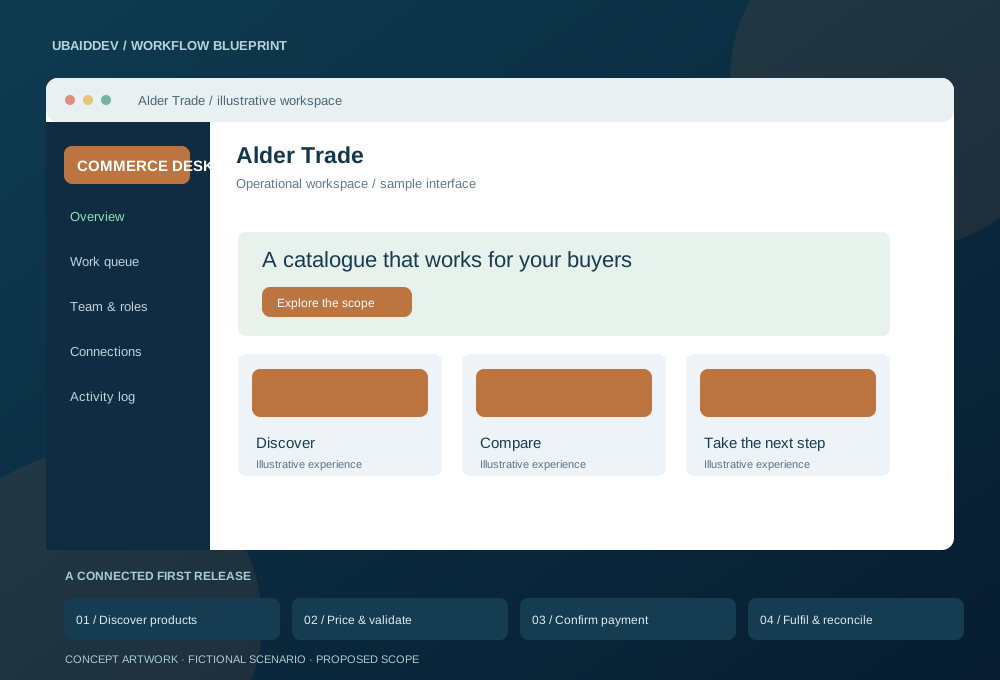
A merchant needs a catalogue that respects stock availability, customer-specific pricing and payment status without forcing staff to reconcile every online order manually.
Calculate totals on the server, reserve stock for a bounded period and verify signed payment webhooks. Separate refunds from order status and document tax and shipping dependencies during discovery.
Measure checkout completion, payment exceptions and staff handling time per fulfilled order.
Targets, baseline, timeline and commercial scope are agreed during discovery.
Agree working-hour overlap, written English updates, staging reviews, migration responsibilities and support scope. Confirm repository access, deployment documentation and ownership terms before work begins.
Choose a delivery tier, functional modules, integrations, and timeline to see an indicative range before discovery.
Explore the range without sharing your email. We confirm the final scope and price after reviewing your requirements.
Count a complete task, such as booking, invoicing or approving a request, as one workflow.
These selections travel with your brief. The range below is calculated from the tier, workflow count, connected systems and delivery pace.
This planning range uses the selected scope inputs. Final deliverables, exclusions, and milestone prices are confirmed in writing.
This does not place an order. We review the configuration and reply with the confirmed scope and milestone proposal.
Answers about scope, integrations, delivery and ownership.
Yes. The operations layer can keep an approved storefront while connecting payment, inventory, fulfilment, return, and support workflows through documented platform capabilities.
Integration contracts use provider verification, idempotency keys, transactional updates, retries, and reconciliation queues. The system records partial or failed state instead of pretending an unconfirmed operation succeeded.
Yes, when each channel has an agreed product, inventory, order, and promotion ownership model. We start with representative journeys and exceptions before expanding the integration set.
Share your requirements and get a clear scope, delivery plan and quote.