Your Source Code
Clear repository handover
Build high-converting Shopify storefronts tailored to your catalog. Develop custom themes, private apps and automated inventory synchronization workflows.
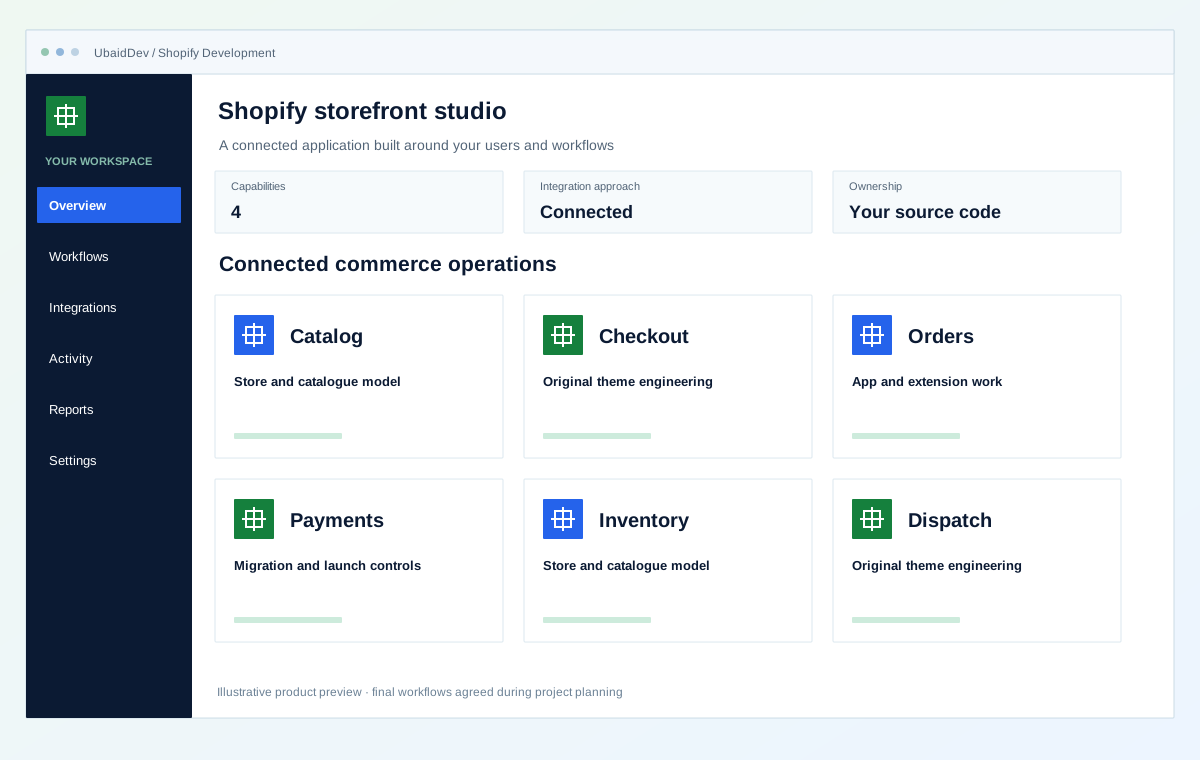
Clear repository handover
Integrations scoped to your tools
Validate each delivery phase
Documentation and onboarding
Define the result you need from shopify development, then review it against real workflows.
Original sections, templates, settings, and source history support merchant editing and controlled releases.
App and checkout capabilities are selected against current Shopify support and ownership needs.
Catalogue, inventory, fulfilment, customer, and reporting integrations include retry and reconciliation paths.
Choose the capabilities that fit your first release and the way your business works.
Products, variants, collections, markets, taxes, shipping, and account needs are mapped.
Responsive Liquid sections use merchant settings and accessible interaction states.
Custom capabilities use supported Shopify APIs and extension points.
Trial imports, redirects, analytics, payments, integrations, and operational checks precede cutover.
Interactive operational simulation for shopify development. Walk through the operational stages to inspect data contracts, user actions, and backend verification hooks before kickoff.
Illustrative screens and sample measurements. These are not live results or performance guarantees.
Stage 1 of 3 · Theme
Products, variants, collections, markets, taxes, shipping, and account needs are mapped.
Responsive Liquid sections use merchant settings and accessible interaction states.
Custom capabilities use supported Shopify APIs and extension points.
Agree on the workflows, review points and release checks before implementation begins.
Roles, authentication and data handling follow the agreed application scope.
Your repository and technical documentation are part of the delivery plan.
Review realistic scenarios, integrations and recovery paths before launch.
Validate the work in planned phases with clear owners and acceptance criteria.
Review the current problems and the people who need the system before selecting features.
Describe the product structure, merchandising needs and integrations that support orders. Separate theme presentation from app behaviour and operational rules. This makes it easier to judge which changes belong in the storefront and which depend on the platform or another service.
A merchant launching bundles needs clear product selection, stock expectations and order information for fulfilment. Review the whole journey before choosing an app or custom extension solely from its demo.
Review representative products, navigation, checkout handoff and fulfilment data. Document app dependencies and verify redirects when replacing an existing storefront.
Configure the agreed catalogue, storefront templates and order workflow. Review the theme, required apps and checkout boundaries against the way the team will maintain products and fulfil orders.
Additional markets, specialist apps and more complex merchandising can follow when the initial store workflow and operating costs are understood.
A transparent process with decisions and handover planned at each stage.
Confirm Shopify supports the catalogue, markets, checkout, and operating model.
Define data, theme sections, app boundaries, and critical journeys.
Implement in controlled environments and rehearse data movement.
Check redirects, payments, tax, shipping, analytics, webhooks, and ownership.
Select the stack and connections around your environment, data and delivery requirements.
Confirm the final deliverables and ownership terms in the project scope.
Shopify theme and configuration source
Approved app extensions and integrations
Catalogue migration and redirect plan
Merchant, release, and operations handover
See how a business requirement becomes a practical system, with a clear scope and checks your team can review.
B2B & retail commerce
A buying journey built around real order rules.
Fictional scenario name · Proposed implementation · Concept artwork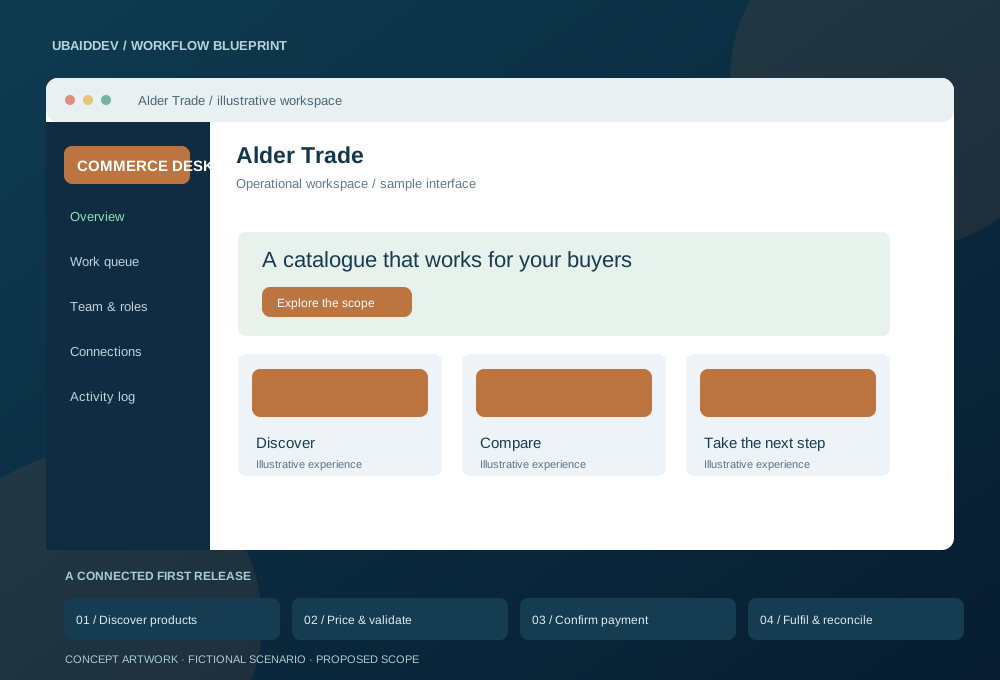
A merchant needs a catalogue that respects stock availability, customer-specific pricing and payment status without forcing staff to reconcile every online order manually.
Calculate totals on the server, reserve stock for a bounded period and verify signed payment webhooks. Separate refunds from order status and document tax and shipping dependencies during discovery.
Measure checkout completion, payment exceptions and staff handling time per fulfilled order.
Targets, baseline, timeline and commercial scope are agreed during discovery.
Agree working-hour overlap, written English updates, staging reviews, migration responsibilities and support scope. Confirm repository access, deployment documentation and ownership terms before work begins.
Choose a delivery tier, functional modules, integrations, and timeline to see an indicative range before discovery.
Explore the range without sharing your email. We confirm the final scope and price after reviewing your requirements.
Count a complete task, such as booking, invoicing or approving a request, as one workflow.
These selections travel with your brief. The range below is calculated from the tier, workflow count, connected systems and delivery pace.
This planning range uses the selected scope inputs. Final deliverables, exclusions, and milestone prices are confirmed in writing.
This does not place an order. We review the configuration and reply with the confirmed scope and milestone proposal.
Answers about scope, integrations, delivery and ownership.
Yes. Original Liquid sections and merchant settings can provide controlled editing without making every page dependent on a third-party builder.
Yes, when the system offers an approved interface. The integration accounts for API limits, webhooks, retries, and reconciliation.
Yes. We map catalogue, customer, order where permitted, content, and URLs, then rehearse the import and redirect plan before cutover.
Share your requirements and get a clear scope, delivery plan and quote.