Your Source Code
Clear repository handover
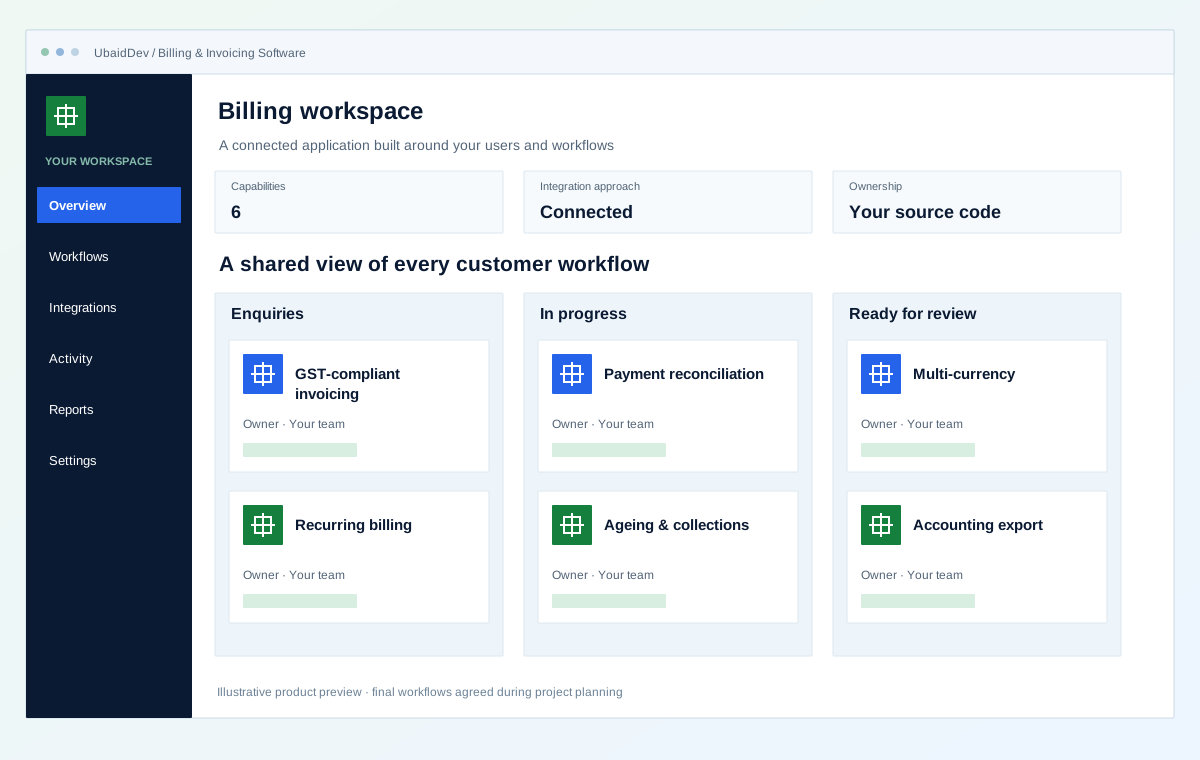
Connect completed work to automated invoices, payment records and clear ledger balances. Model your billing rules, approvals and accounting integrations.
Clear repository handover
Integrations scoped to your tools
Validate each delivery phase
Documentation and onboarding
Define the result you need from billing & invoicing software, then review it against real workflows.
Automated reminders on a schedule, and an ageing report that shows who to chase today. Late payment is usually a follow-up problem, not a customer problem.
Reconciliation against payment-gateway and bank feeds happens continuously instead of being assembled manually at month end.
Failed recurring charges, unbilled work and cancelled-but-still-charging subscriptions are the three quiet leaks. Each gets a report rather than being discovered by accident.
No per-invoice or per-seat fee. Sending ten thousand invoices costs the same as sending ten.
Choose the capabilities that fit your first release and the way your business works.
Correct tax breakdown, sequential numbering, credit notes.
Subscriptions with proration, pause, resume and retry on failure.
Gateway and bank feeds matched to invoices automatically.
Who owes what, for how long, with reminder schedules.
Bill overseas clients with the rate recorded at invoice date.
Clean export into Tally, Zoho Books, QuickBooks or Xero.
Interactive operational simulation for billing & invoicing software. Walk through the operational stages to inspect data contracts, user actions, and backend verification hooks before kickoff.
Illustrative screens and sample measurements. These are not live results or performance guarantees.
| Work item | Stage | Owner |
|---|---|---|
| GST-compliant invoicingExample record 01 | Draft | Engineering Team |
| Recurring billingExample record 02 | Approve | Engineering Team |
| Payment reconciliationExample record 03 | Reconcile | Engineering Team |
| Ageing & collectionsExample record 04 | Draft | Engineering Team |
Correct tax breakdown, sequential numbering, credit notes.
Stage 1 of 3 · Draft
Correct tax breakdown, sequential numbering, credit notes.
Subscriptions with proration, pause, resume and retry on failure.
Gateway and bank feeds matched to invoices automatically.
Agree on the workflows, review points and release checks before implementation begins.
Roles, authentication and data handling follow the agreed application scope.
Your repository and technical documentation are part of the delivery plan.
Review realistic scenarios, integrations and recovery paths before launch.
Validate the work in planned phases with clear owners and acceptance criteria.
Review the current problems and the people who need the system before selecting features.
Start with how charges are created, approved, corrected and reconciled. Billing software should reflect the agreement with the customer and keep a clear record of changes. Identify the source of line items and who can alter a draft before it becomes an issued document.
A service company may bill a deposit followed by milestones. The workflow needs to distinguish an issued invoice, a recorded payment and an adjustment, so the team can explain the balance without editing old records silently.
Review partial payments, overdue states, corrections and exports with sample records. Confirm local invoicing requirements with the responsible business adviser before finalising the document format.
Cover the agreed path from customer and line items to a reviewed invoice, payment record and export. Confirm numbering, calculation rules and correction handling with the responsible team.
Recurring billing, additional business entities and wider accounting integrations can follow after the initial invoice and reconciliation process is established.
A transparent process with decisions and handover planned at each stage.
Tax, discounts, proration, credit notes — written down before code.
Invoices and payments as an append-only record, so history cannot silently change.
Gateway integration with idempotent webhooks so a retry never double-charges.
Ageing, revenue and tax reports verified against a period you already closed.
Select the stack and connections around your environment, data and delivery requirements.
Confirm the final deliverables and ownership terms in the project scope.
Source code and database schema, owned by you
Invoice templates matching your branding and legal requirements
Reconciliation report you can run for any period
Ageing report and reminder schedule
Accounting-software export, tested against a real period
Audit trail on every amount change
See how a business requirement becomes a practical system, with a clear scope and checks your team can review.
Distribution & multi-location operations
One order. A connected operational journey.
Fictional scenario name · Proposed implementation · Concept artwork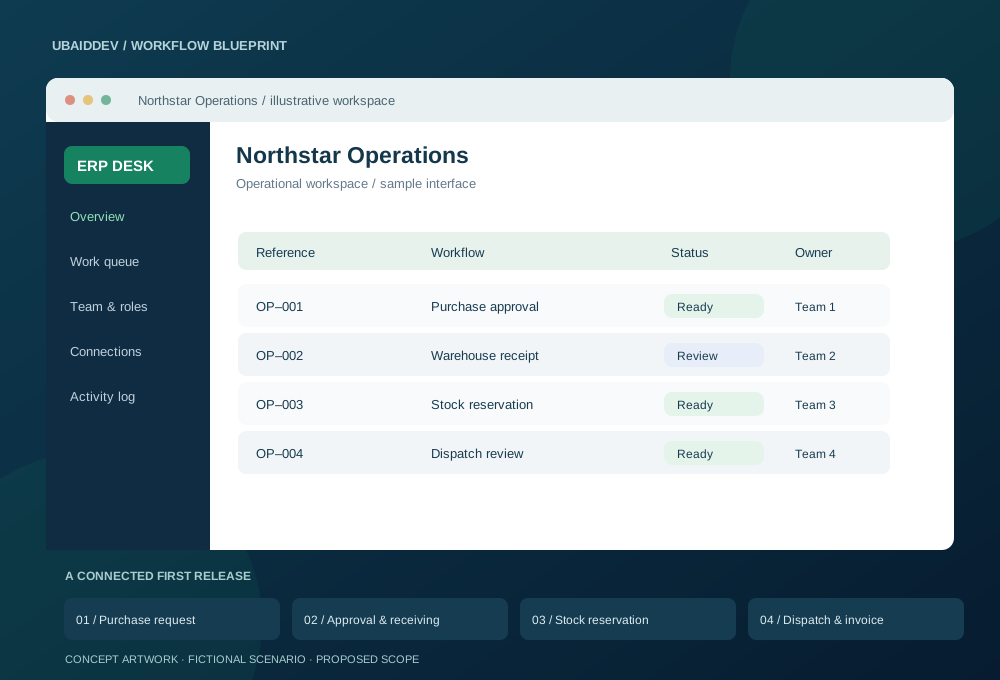
A growing distributor manages purchasing, warehouse stock and invoices in separate spreadsheets. Teams need to know what is available, who approved a purchase and which orders are ready to ship.
Use a transactional stock ledger, approval thresholds and idempotent accounting connectors. Import opening balances into a staging environment and reconcile them before cutover.
Track stock discrepancies, order-to-dispatch time and manual reconciliation hours against the pre-launch baseline.
Targets, baseline, timeline and commercial scope are agreed during discovery.
Agree working-hour overlap, written English updates, staging reviews, migration responsibilities and support scope. Confirm repository access, deployment documentation and ownership terms before work begins.
Choose a delivery tier, functional modules, integrations, and timeline to see an indicative range before discovery.
Explore the range without sharing your email. We confirm the final scope and price after reviewing your requirements.
Count a complete task, such as booking, invoicing or approving a request, as one workflow.
These selections travel with your brief. The range below is calculated from the tier, workflow count, connected systems and delivery pace.
This planning range uses the selected scope inputs. Final deliverables, exclusions, and milestone prices are confirmed in writing.
This does not place an order. We review the configuration and reply with the confirmed scope and milestone proposal.
Answers about scope, integrations, delivery and ownership.
It produces GST-compliant invoices with correct tax breakdown, sequential numbering and credit notes, and exports in the formats your accountant needs for GSTR filing. We build to your accountant's requirements and will work with them during scoping — we do not file returns ourselves.
Yes: proration, pause and resume, retry on failed payment, and dunning emails. Cancellation stops billing in the same system that charges, which is the failure we see most often.
We build an export for Tally, Zoho Books, QuickBooks or Xero and test it against a period you have already closed, so you can verify the numbers match before relying on it.
It never touches your system. Cards are tokenised by the payment gateway and we store only the token, which keeps you out of PCI scope for card storage.
Share your requirements and get a clear scope, delivery plan and quote.