Query profiling
Find the queries actually costing time, with numbers rather than intuition.
Keep business data performant as your application grows. Optimize slow queries, plan zero-loss database migrations and verify backup restoration procedures.
We eliminate speculative quotes and opaque management layers. Every project is scoped directly by the engineers writing the code, adhering to non-negotiable architectural standards, continuous testing, and full code handover.
Edge-distributed static assets and sub-second database query execution.
Zero single point of failure with automated health checks and container failover.
Unconditional repository, database schema, and design token handover.
Direct architecture scoping and sprint delivery without management layers.
TLS 1.3 in transit, automated backups, and zero hardcoded credentials.
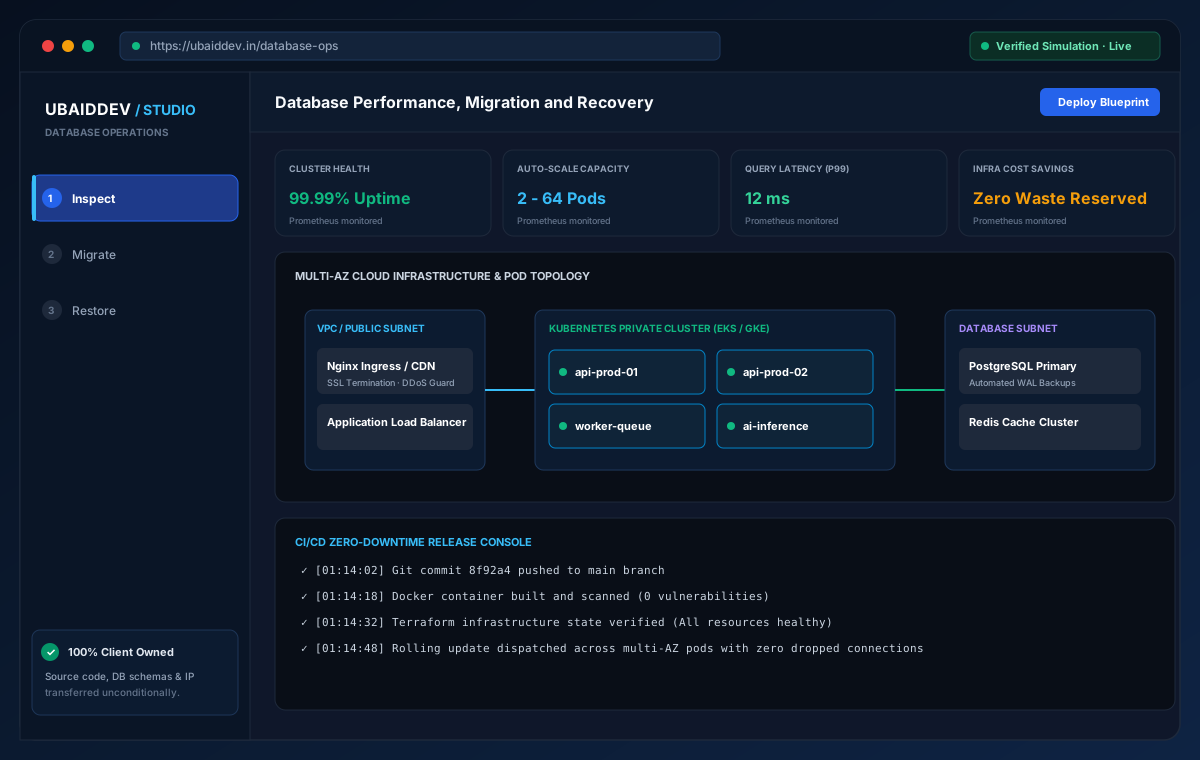
Interactive operational simulation for database performance & operations. Walk through the operational stages to inspect data contracts, user actions, and backend verification hooks before kickoff.
Illustrative screens and sample measurements. These are not live results or performance guarantees.
// Terraform & Kubernetes State
Cluster: production-vpc-01 (Multi-AZ)
Nginx Ingress: SSL A+ | DDoS Protected
Database: PostgreSQL Primary + Replica
Current Task: "Query profiling"
Ownership: 100% Client Cloud Accounts
Stage 1 of 3 · Inspect
Find the queries actually costing time, with numbers rather than intuition.
Add what is needed, remove what is only slowing writes down.
Where the model no longer matches how the data is used.
A page that got slower every month and nobody profiled it, so the cause is a guess.
Discuss your requirementsValidated entry point
Find the queries actually costing time, with numbers rather than intuition.
MongoDB
Human-visible outcome
Understand the decisions, prepare a useful brief and know what to review before launch.
Describe the slow operations, the size and shape of the data, and the hours when changes are acceptable. Performance work should be tied to repeatable examples. Recovery work should be tied to a business decision about how much data loss and downtime can be tolerated.
We start with your workload, current risks and the people who will maintain the system. Environments, access, monitoring and backups should be understandable. A deployment is incomplete without a tested recovery approach and a handover your team can follow.
A starting point for discussion. Agree the final release boundaries during discovery.
Establish a baseline for the most important queries and maintenance tasks. Review access, indexes and backup recovery, then make agreed changes with a way to compare results and reverse them.
Data partitioning, replicas, larger migrations and changes to the application data model need their own scope and operating plan.
A reporting query may slow down order processing at the end of the day. Compare the query plan and workload before changing indexes or moving reporting work. Keep a baseline so the effect of a change can be reviewed.
Ask for before-and-after measurements, migration checks and recovery instructions. Validate record counts and critical relationships against a representative data sample.
Agree how much recent data the business can afford to lose and how quickly the service must recover. Test a restore in a separate environment, record the steps and assign an owner. Apply the same discipline to deployment rollback and access recovery.
See the common operating problem, its likely cause, the business impact, and the control a custom database performance & operations build can introduce. These are planning examples; your priorities and acceptance criteria are confirmed during discovery.
Recognize one of these problems?
Build an indicative database performance & operations scope first. No email is required to see the range.
“A page that got slower every month and nobody profiled it, so the cause is a guess.”
Zero-runtime headless architecture, Partytown web-worker execution for marketing tags, and server-side cached rendering.
Select the modules, integrations, and delivery pace that fit your situation. See an indicative range first, or send your current workflow for a human review.
Illustrative planning only · Final scope, acceptance criteria, timing, and milestone pricing are confirmed in writing.
Start with the work your team needs to improve. Agree on the workflow, the people responsible and the checks that will show whether the new system is ready to use.
Every outcome is verified against production telemetry benchmarks established during discovery before full deployment.
A report that takes forty seconds does not get run. Making it fast is often the difference between a feature being used and being ignored.
Scaling hardware to compensate for a missing index is the expensive way to fix it, and the cost recurs monthly.
Before and after timings on the same queries. This is one of the few pieces of work where you can verify the claim yourself.
Each item below represents an engineered, verifiable deliverable—not vague marketing promises. Everything we build is deployed to your private infrastructure with container blueprints, documented runbooks, and zero vendor lock-in.
Find the queries actually costing time, with numbers rather than intuition.
Add what is needed, remove what is only slowing writes down.
Where the model no longer matches how the data is used.
Rehearsed on a copy, with a reversal path, before touching production.
A restore performed, because an unrestored backup is untested.
Measured timings, so the improvement is checkable.
Choose an infrastructure tier, delivery stages, cloud integrations, and timeline to see an indicative range before discovery.
Explore the range without sharing your email. We confirm the final scope and price after reviewing your requirements.
Count the distinct setup or release stages your team needs to operate.
These selections travel with your brief. The range below is calculated from the tier, workflow count, connected systems and delivery pace.
This planning range uses the selected scope inputs. Final deliverables, exclusions, and milestone prices are confirmed in writing.
This does not place an order. We review the configuration and reply with the confirmed scope and milestone proposal.
Describe the workflow you are trying to fix and we will reply with the smallest build that solves it — including what we would leave out of phase one and why. If an off-the-shelf tool is the better answer for you, we will say so instead of quoting.
Delivery Roadmap
Baseline timings captured before anything changes.
The specific queries and schema decisions responsible.
Changes applied to a copy first, then to production in a window you choose.
Before and after figures, plus what to watch going forward.
Scope Levers
Nothing here ships as a fixed package. Delivery opens with "Measure" — Baseline timings captured before anything changes — and that is the step where the scope below gets decided with you.
6 areas make up this build. Which of them you need, how deep each goes, and what ships first is set per client — we customise the depth rather than charging for shelfware.
Where your team already has tooling, the build fits it instead of replacing it. These are the defaults we start from, swapped when your environment calls for something else.
There are limits to what we will bend, and they are listed under “when this is the wrong service to buy” below.
Concrete artefacts, source code, and configurations owned 100% by you on delivery.
Cases where we would tell you not to spend the money, or where a cheaper tool fits better.
Commercial Terms
No retainer minimums, no discovery fee, and no proposal that hides the price on page nine. These terms are the same for every project on this page.
Scope is priced before work starts and billed per completed milestone. No hourly meter and no invoice you did not see coming.
Repository, database and hosting accounts sit in your name from day one. Stopping work never costs you access to anything.
We sign first, then you send exports, screenshots or credentials. Nothing becomes a public case study without written approval.
You talk to the person writing the code, not an account manager relaying your requirements second-hand.
Direct Answers
Because the work depends on what profiling finds. We scope a fixed number of hours for the diagnosis, share the findings, and quote the fix separately — so you are never paying for work before knowing whether it is needed.
We will not give a figure before profiling. Missing indexes on a large collection can be dramatic; a query that is already well-indexed may barely move. You get the before and after numbers either way.
Changes are rehearsed on a copy and a verified backup exists before anything runs against production. Migrations carry a reversal path. We will not run a schema change with no way back.
Bangalore, India — MongoDB and PostgreSQL, self-hosted or managed.
Choose your next step
All three go to the same small team. None of them puts you on a mailing list.
Projects rarely stop at Database Performance & Operations. These are the adjacent capabilities most often folded into the same delivery plan.
Share your current operational bottleneck and target timeline. We reply within 24 hours with an architectural blueprint, scope range, and fixed milestone pricing.
Get a Fixed Quote