The Sovereign Engineering Thesis: Why High-Growth Businesses Build Custom Software Instead of Renting Generic SaaS
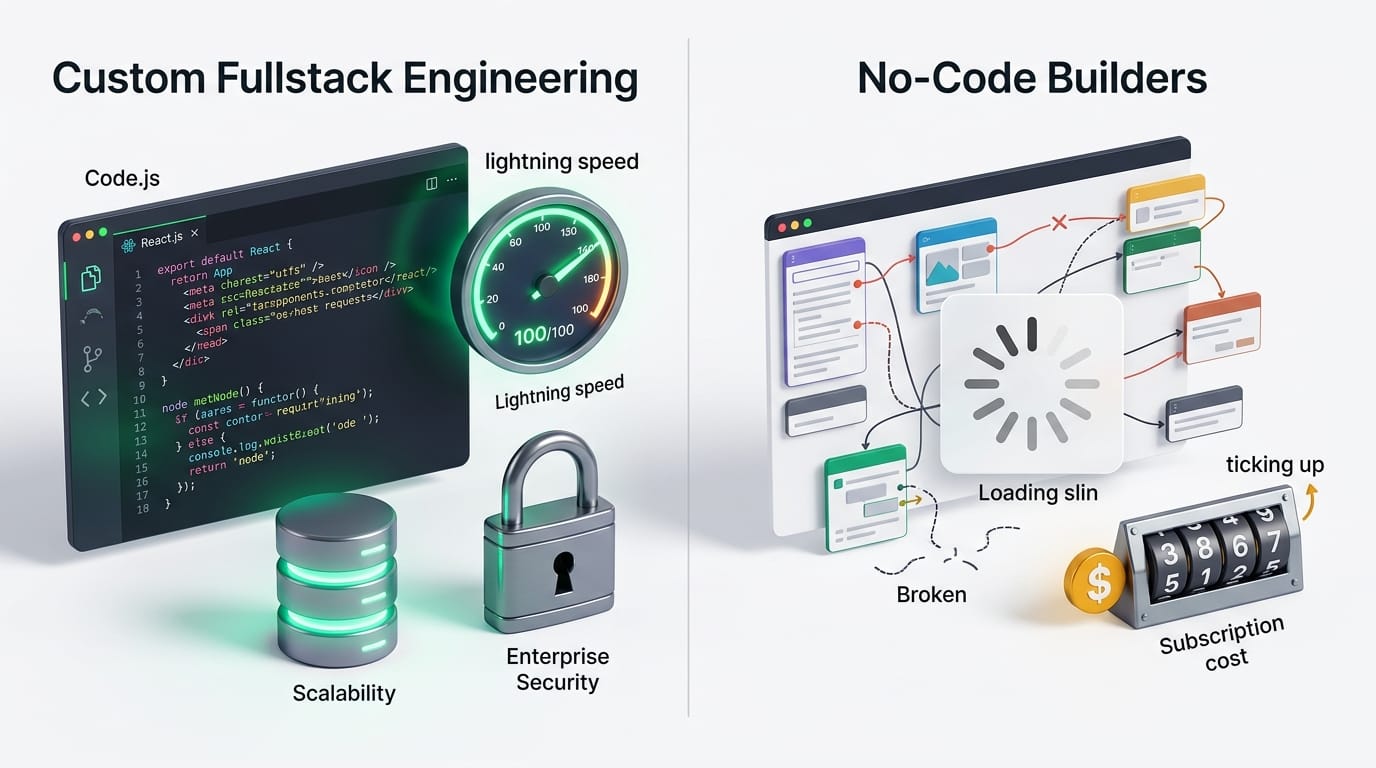
In 2026, software is no longer a peripheral back-office utility—it is the operational backbone, customer interface, and primary balance-sheet asset of modern enterprises. While off-the-shelf SaaS solutions offer immediate setup, they impose a compounding per-seat tax, artificial feature paywalls, and rigid workflow constraints that actively hinder business differentiation. By contrast, investing in custom software development delivers 100% intellectual property ownership, zero recurring per-user fees, bespoke automation tailored to your exact margins, and lasting competitive advantage.
What Is Custom Software Development?
Custom software development (often termed bespoke software development or tailored enterprise software) is the disciplined process of designing, architecting, engineering, and deploying software applications tailored precisely to the operational requirements, security protocols, and strategic goals of a specific organization.
Unlike mass-market commercial off-the-shelf (COTS) software—such as generic CRM tools or rigid ERP subscriptions designed as a lowest-common-denominator compromise for millions of diverse users—custom business software is engineered to match your proprietary operational workflows, business rules, and compliance standards.
- ✓ 100% owned source code, database schemas, and intellectual property.
- ✓ Zero per-seat or monthly recurring licensing fees as team scales.
- ✓ Unlimited custom API integrations with ERP, WhatsApp, and banking gateways.
- ✓ Engineered specifically around your company's highest-margin operations.
- ✗ Zero equity value; you rent access on a monthly per-seat basis.
- ✗ Monthly bills increase automatically every time you hire a team member.
- ✗ Essential capabilities (SSO, audit logs, custom webhooks) locked behind 5x pricing tiers.
- ✗ Your team is forced to change its proven internal processes to fit SaaS limits.
How It Works & The Modern Engineering Lifecycle
Modern custom software engineering has evolved far beyond the sluggish, multi-year waterfall projects of the past. Today, specialized software development companies utilize modular monoliths, typed contracts, sub-second continuous deployment, and AI-accelerated development workflows to deliver production-ready systems in weeks rather than years.
The lifecycle consists of four interconnected operational domains:
Architectural Discovery & Domain Modeling
Before writing a single line of application code, senior architects map data flows, state machines, user personas, transactional volume, and database integrity requirements to produce an exact Blueprint Specification.
Database Schema & Strict Typed Contracts
PostgreSQL normalized DDL, Row-Level Security (RLS), foreign key cascades, and OpenAPI/TypeScript contracts ensure zero schema drift, sub-millisecond index lookups, and atomic ledger compliance.
Iterative Bi-Weekly Milestone Sprints
Features are deployed directly to a staging environment every two weeks. Stakeholders test actual working software with genuine team data rather than static presentation slides.
Zero-Downtime Cutover & Automated CI/CD
Automated containerized pipelines deploy updates with zero user disruption. Continuous backups, SSL termination, and automated database replication protect critical operations 24/7.
Key Features & Components of Modern Enterprise Software
Every high-performance custom application engineered at UbaidDev is built on top of battle-tested enterprise primitives that guarantee security, maintainability, and horizontal scalability:
Granular RBAC & Tenant Isolation
Enforce role-based access control with PostgreSQL Row-Level Security so sensitive financial data is strictly separated between branches, managers, and employees.
Real-Time Event Streams & Webhooks
Instant Redis Pub/Sub, WebSockets, and idempotent webhooks keep dispatch boards, inventory counters, and executive analytics updated in real-time.
Automated WhatsApp & SMS Triggers
Trigger automated WhatsApp template notifications, PDF invoice dispatches, payment links, and dispatch alerts without manual operator overhead.
Double-Entry Financial Ledgers
ACID-compliant immutable debit/credit tables prevent discrepancies, reconcile multi-currency balances, and generate audited balance sheets in seconds.
AI Automation & LLM Workflows
Embed localized RAG agents, intelligent document parsing, automated ticket classification, and predictive demand forecasting directly into daily workflows.
Sub-50ms Global Edge Speeds
Lightweight frontend architectures built with React, Next.js, or Vite load in under 600ms, driving superior staff productivity and high conversion rates.
Business Benefits & ROI vs Off-the-Shelf SaaS
When assessing whether to build custom software or subscribe to commercial SaaS, forward-thinking CFOs evaluate Total Cost of Ownership (TCO) across a 3 to 5-year operational horizon.
| Strategic Parameter | Commercial SaaS (Salesforce, SAP, NetSuite) | Custom Software (UbaidDev) |
|---|---|---|
| 5-Year Licensing Cost (50 Seats) | $360,000 – $600,000 (Recurring drain) | $25,000 – $45,000 (One-time capital asset) |
| Cost to Add 100 New Users | +$10,000 to +$20,000 every single month | $0.00 / month (Unlimited users) |
| Intellectual Property Ownership | 0% (Rented access, zero balance sheet equity) | 100% Perpetual IP & Git Code Ownership |
| Workflow Alignment | Generic compromise; staff adjusts to software | 100% tailored to your competitive advantage |
| Custom Database Queries & BI | Throttled API quotas, heavy export fees | Direct SQL access, custom dashboards, zero limits |
Custom Software Development Cost in 2026: Complete Pricing Breakdown
Transparent pricing is critical for realistic business budgeting. In 2026, custom business software costs depend on system complexity, integration count, data migration requirements, and real-time concurrency. Below are realistic market benchmarks engineered by UbaidDev:
1. Small Business Application / Internal Workflow Tool
$5,000 – $15,000 (₹4L – ₹12L)Designed for single-location companies, clinics, boutique agencies, or fast-growing trade businesses looking to replace error-prone spreadsheets with a reliable, multi-user web application.
- Timeline: 3 to 5 weeks.
- Scope: Core operational database, role permissions (Admin vs Staff), automated invoice generation, WhatsApp customer reminders, and lightweight executive dashboard.
2. Mid-Market Operational Platform / Dedicated SaaS Product
$18,000 – $40,000 (₹15L – ₹35L)Targeted at organizations with 20 to 200 employees, multi-branch operations, proprietary e-commerce platforms, or founders launching a commercial B2B SaaS product.
- Timeline: 6 to 10 weeks.
- Scope: Multi-warehouse inventory, customer self-service portals, payment gateway integrations (Stripe, Razorpay), automated ledger reconciliation, background task queues, and mobile-responsive PWA.
3. Enterprise Custom Suite (Complete ERP / Core Banking / Logistics)
$45,000 – $95,000+ (₹38L – ₹80L+)Comprehensive mission-critical enterprise systems designed to completely replace million-dollar SAP or NetSuite deployments with proprietary, perpetual infrastructure.
- Timeline: 12 to 20 weeks across iterative milestone phases.
- Scope: High-concurrency database clusters, multi-tenant row-level security, hardware barcode scanner dispatch integration, legacy ETL data migration, compliance auditing, and 24/7 high-availability SLA.
Step-by-Step Software Development Process at UbaidDev
A structured engineering framework eliminates development delays, scope creep, and unexpected cost overruns. Here is our 6-phase engineering process:
Scoping & Fixed-Price Estimate
We define user personas, interface wireframes, and API integrations. You receive an itemized proposal with guaranteed fixed pricing and milestone dates.
Database & Architectural Modeling
We engineer normalized relational schemas in PostgreSQL, defining primary foreign keys, atomic indexes, and automated audit trigger functions.
Full-Stack Sprint Execution
Our senior engineers build the backend APIs, state engines, and responsive user interfaces, delivering continuous preview builds to your team.
Data Migration & Dual-Run Testing
We sanitize and import historical records from your legacy tools. For 14 days, systems run concurrently to verify penny-accurate reporting parity.
Staff Onboarding & Cutover
Interactive training sessions ensure zero operational downtime. All legacy feeds are redirected to the new platform over a scheduled weekend cutover.
Post-Launch Warranty & IP Handover
We deliver complete Git repository access, comprehensive architectural documentation, and a 30-day comprehensive engineering warranty.
Recommended Technology Stack & Architecture for 2026
Choosing the correct technology stack determines software longevity, developer availability, and cloud operational expenditure. We recommend pragmatic, industry-standard technologies:
+-----------------------------------------------------------------------------------+
|                        MODERN ENTERPRISE FULL-STACK ARCHITECTURE                   |
+-----------------------------------------------------------------------------------+
|  FRONTEND LAYER    : React 19, Next.js / Vite, TailwindCSS, TanStack Query       |
|  STATE & UI        : Lucide Icons, Framer Motion, Radix Primitives (Lightweight)  |
+-----------------------------------------------------------------------------------+
|  API & RUNTIME     : Node.js 22 LTS / Python FastAPI, Fastify / Express Engine    |
|  VALIDATION        : Zod Schema Validation, Strict TypeScript Typing              |
+-----------------------------------------------------------------------------------+
|  DATA & PERSIST    : PostgreSQL 16 Enterprise (Primary Write + Analytical Replicas)|
|  CACHE & QUEUE     : Redis 7.2 In-Memory State Cache & BullMQ Background Workers  |
+-----------------------------------------------------------------------------------+
|  SECURITY & AUDIT  : JWT HttpOnly Cookies, AES-256 Object Vault, RBAC Row-Level   |
|  INFRA & DEPLOY    : Docker, Linux VPS (Hetzner / AWS / DigitalOcean), Nginx / Caddy|
+-----------------------------------------------------------------------------------+
Common Challenges in Custom Software & How to Avoid Them
Custom software initiatives fail only when executed without technical discipline. Here is how senior architects prevent common pitfalls:
- Uncontrolled Scope Creep: Prevented by writing exhaustive specification documents before engineering begins and maintaining a strict backlog for post-launch Phase 2 iterations.
- Over-Engineering Microservices Prematurely: Avoid splitting early-stage applications into dozens of distributed microservices. A clean, modular monolith is easier to maintain, cheaper to host, and 10x faster to build.
- Neglecting Data Sanitization: Legacy spreadsheets frequently contain corrupted dates and mismatched customer keys. Automated normalization scripts must clean data in staging before production cutover.
- Lack of Real User Testing: Ensure frontline employees test workflows early in staging to prevent user resistance during rollout.
How to Choose the Right Custom Software Development Company
Selecting the right engineering partner is the single most critical decision in any custom software project. Ask prospective development agencies these five non-negotiable questions:
Frequently Asked Questions About Custom Software Development
How long does it take to develop custom business software?
Most custom software solutions take between 4 and 12 weeks. Small business automation tools launch in 3 to 5 weeks, mid-market platforms take 6 to 10 weeks, and multi-facility enterprise ERP suites take 12 to 18 weeks across clear, progressive milestones.
Can custom software integrate with our existing accounting or payment tools?
Yes. Custom software is engineered around standard REST, GraphQL, or webhook APIs. We routinely connect custom platforms with payment gateways (Stripe, Razorpay), accounting systems (Tally, QuickBooks), WhatsApp Business API, and logistics carriers.
Is custom software secure against cyber threats and data leaks?
Unlike multi-tenant public SaaS where your data shares database tables with millions of strangers, custom software allows isolated private databases, encrypted S3 object vaults, HttpOnly JWT authentication, and strict PostgreSQL Row-Level Security (RLS).
What happens if we need to add new features a year later?
Because you own 100% of the clean, documented source code built with standard open-source technologies, your platform can be expanded at any time by our team or any competent full-stack software engineer.
Conclusion: Stop Paying Rented SaaS Taxes & Build Code Equity
As your business expands in 2026, relying on rigid third-party SaaS subscriptions creates an ongoing financial drag and limits operational agility. By investing in custom software development, you eliminate recurring per-seat fees, gain complete operational sovereignty, and transform your business processes into a valuable corporate asset.
Need Custom Software Built for Your Business?
Work directly with our senior solutions architects to scope your database schema, workflows, and automated integrations with a guaranteed fixed-price estimate.
Explore UbaidDev Digital Product Marketplace
Looking for a head-start? Explore our production-tested, 100% source-code owned digital products, including Next.js SaaS templates, custom CRM modules, and billing engines.
Have Questions About Implementing This Architecture?
Speak directly with Lead Solutions Architect Md Ubaidulla. We review your stack, calculate savings, and outline a fixed scope.